
Pakistan, Türkiye, Qatar and Indonesia Sign New ‘Badr’ Defence MoU — How Concerned Should India Be?
Doha, Qatar | October 22, 2026 | The Global Journal
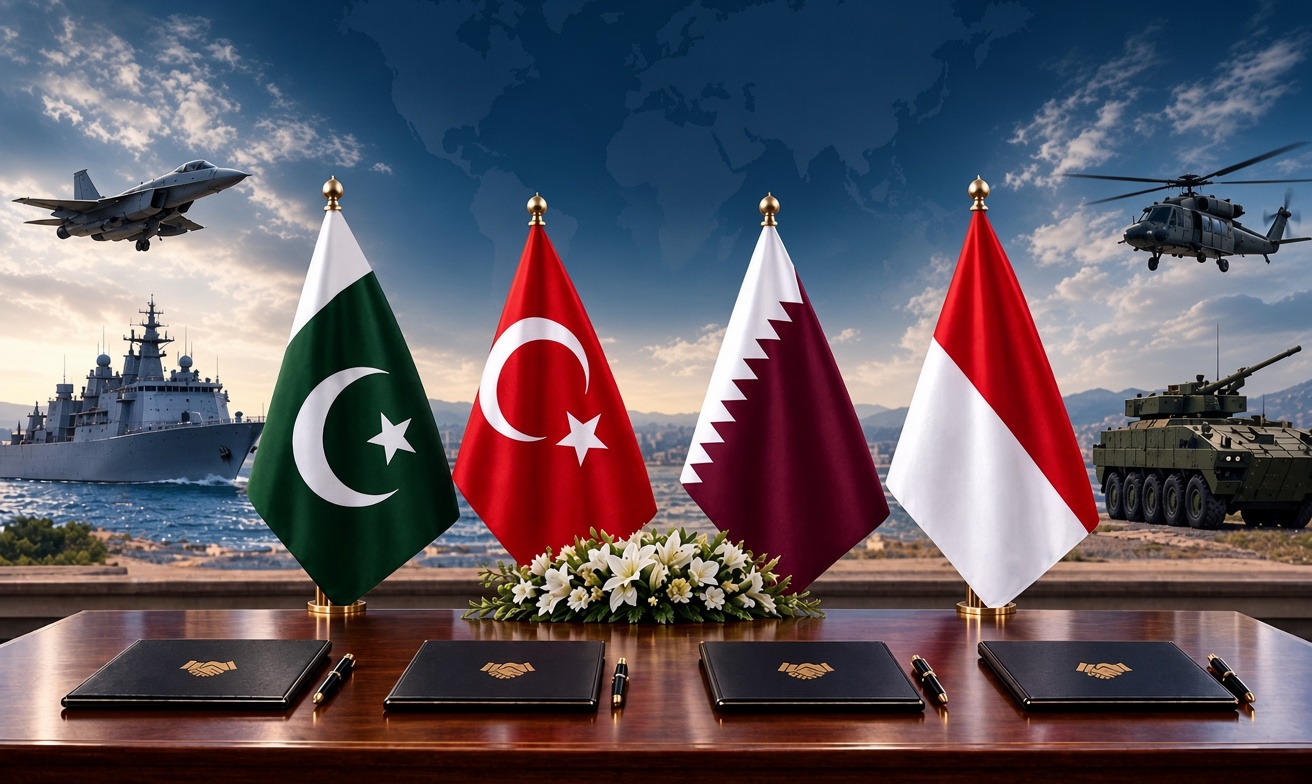
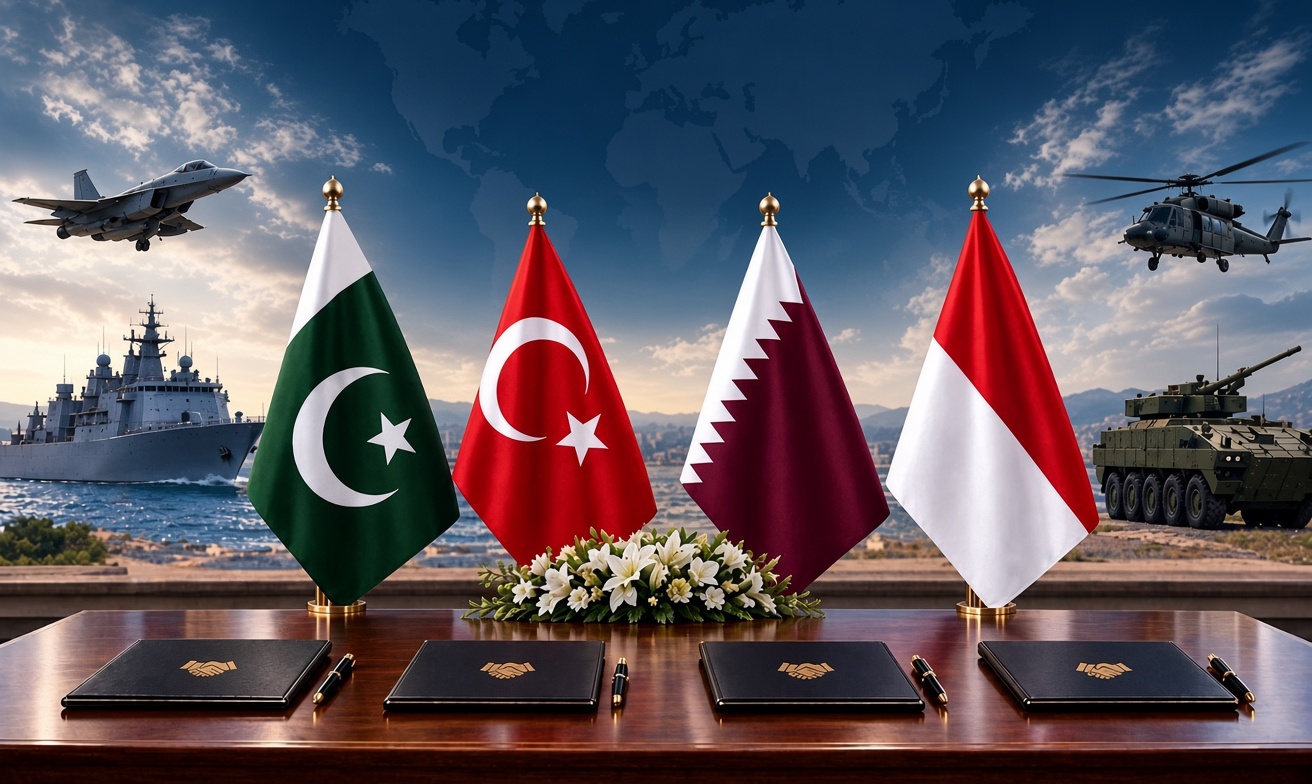
Pakistan, Türkiye, Qatar and Indonesia have signed a memorandum of understanding (MoU) aimed at strengthening military capabilities, expanding joint defence production and deepening cooperation in technological research. Known as the ‘Badr Memorandum of Understanding,’ the initiative could broaden Pakistan’s defence partnerships and potentially influence the regional security landscape across South Asia and the Middle East.
Representatives of the four countries signed the agreement in Doha, the Qatari capital, on Wednesday, October 21. The participants included Pakistan’s Defence Minister Khawaja Asif, Türkiye’s Defence Minister Yaşar Güler, Qatar’s Deputy Prime Minister and Minister of State for Defence Sheikh Saud bin Abdulrahman, and Indonesia’s Deputy Defence Minister Yusuf Jauhari.
The stated objective is to expand cooperation in defence production, military training, research and development, and advanced defence technologies. However, the MoU is not a formal military alliance that obliges the signatories to defend one another against an attack. Its potential impact must therefore be assessed by distinguishing its stated goals from the projects that may eventually emerge.
What Are the Main Objectives of the Badr MoU?
Under the Badr MoU, the four countries aim to use their respective defence-industrial capabilities and expertise to expand cooperation in joint production, technical training and military research. The arrangement could create opportunities for greater coordination in developing, manufacturing and supplying modern defence equipment.
The agreement takes its name from the Battle of Badr, fought in 624 CE during the early history of Islam. In their joint statement, the four countries reportedly associated the word “Badr” with a “full moon” and highlighted the complementary capabilities of the participating nations.
According to remarks attributed to Haluk Görgün, head of Türkiye’s Defence Industries Presidency, the MoU could provide a foundation for turning joint production and technological cooperation into practical projects.
The four countries may bring complementary strengths to the partnership. Türkiye has an established defence-industrial infrastructure and technological expertise. Qatar could potentially contribute financing, while Pakistan offers defence-manufacturing capabilities, a skilled workforce and a substantial domestic market. Indonesia, meanwhile, has experience in local production and collaborative technology development.
How Could Joint Production and Technology Cooperation Work?
According to published reports, the four countries are expected to identify their respective national-security requirements and defence priorities. An executive board would then develop plans for joint production and cooperation. These proposals could be submitted to a strategic board, which may make decisions on matters such as budgets and production locations.
The reports also mention the possibility of establishing joint production facilities in Türkiye. However, the agreement’s practical capabilities will remain difficult to assess until further details are disclosed about specific weapons systems, production targets, financing arrangements and technology-transfer conditions.
Why Is This Defence Initiative Emerging Now?
The initiative comes amid continuing security challenges in the Middle East, tensions between the United States and Iran, and conflict involving Saudi Arabia and Yemen’s Houthi group. Regional instability has heightened concerns about arms supplies, dependence on foreign technology and national defence preparedness.
Defence analysts suggest that countries are exploring alternative partnerships to reduce excessive dependence on foreign suppliers, address restrictions on technology transfers and mitigate the risks of disruptions to international supply chains.
According to published reports, US Ambassador to Türkiye Tom Barrack also stressed the need for Middle Eastern countries to take greater responsibility for their own security while speaking in Doha on October 20. Against this backdrop, efforts to expand defence cooperation among regional and partner countries are gaining significance.
How Does the Badr MoU Differ From the Mecca Defence Agreement?
The Badr MoU is being compared with the Mecca Joint Defence Agreement reportedly signed by Pakistan, Saudi Arabia and Türkiye in August. However, the two arrangements have different objectives and structures.
According to published reports, the Mecca agreement includes a principle under which an armed attack against any one of the three countries would be treated as an attack against all of them. By contrast, the Badr MoU primarily focuses on defence industries, joint production, training, research and technological cooperation.
There is therefore insufficient basis to describe the Badr MoU as a mutual-defence military alliance. Nevertheless, the possibility that the two forms of cooperation could complement each other in the future cannot be ruled out.
How Concerned Should India Be?
For India, the significance of the Badr MoU lies mainly in the possibility that Pakistan could expand its defence capabilities and international partnerships. Pakistan currently relies substantially on China for military equipment. Greater defence cooperation with Türkiye, Qatar and Indonesia could provide Islamabad with additional opportunities to access technologies, pursue joint manufacturing and modernise its military equipment.
If implemented, such cooperation could also benefit Pakistan’s domestic defence industry. However, signing an MoU does not mean that new weapons deliveries or technology transfers have already begun. The actual impact will depend on subsequent agreements, projects, financing and the conditions governing technology sharing.
Another important consideration for India is its defence cooperation with Indonesia. Published reports have referred to agreements involving the supply of BrahMos cruise missiles and Astra air-to-air missiles in discussions of India–Indonesia defence ties.
This has raised questions about whether closer technological cooperation among the four Badr signatories could create any risk of sensitive information about Indian-supplied weapons reaching Pakistan.
However, Sudhir Kumar Mishra, chairman emeritus of India’s Defence Research and Development Organisation (DRDO) and former head of BrahMos Aerospace, has reportedly said that appropriate safeguards are included in India’s defence arrangements with Indonesia. According to his remarks, Jakarta would receive operating manuals for the weapons, rather than documents transferring the underlying technology.
Retired Group Captain Ajay Ahlawat has also argued that signing an MoU does not automatically create a military alliance. In his assessment, the language of the Badr agreement points primarily towards defence cooperation and a framework for sharing work. India also maintains relations with Qatar and Indonesia.
What Could Change in Regional Security?
If the Badr MoU develops into concrete projects, cooperation among the four countries could expand in defence manufacturing, technological development and military training. This could broaden Pakistan’s defence partnerships while creating further opportunities for Türkiye to increase its regional influence in the defence-industrial sector.
The agreement’s actual strategic impact, however, will depend on how far joint production projects advance, how much funding is committed and what conditions govern the sharing of sensitive military technologies.
India therefore has strategic reasons to monitor the agreement’s implementation, particularly any growth in Pakistan’s technological capabilities and the safeguards governing India’s defence cooperation with Indonesia. Nevertheless, based on the information currently available, it would be premature to characterise the Badr MoU as a military alliance formed against India.
The Badr Memorandum of Understanding represents a new initiative to expand defence-industrial and technological cooperation among Pakistan, Türkiye, Qatar and Indonesia. It could offer Pakistan an opportunity to diversify its defence partnerships, while giving India reason to closely monitor its implementation and potential technological implications.
Ultimately, the agreement’s strategic significance will be determined not by the announcement alone, but by the concrete steps the four countries take to put it into practice.
Sources: Firstpost reporting, along with statements and material attributed to Al Jazeera, Middle East Eye and relevant defence officials.