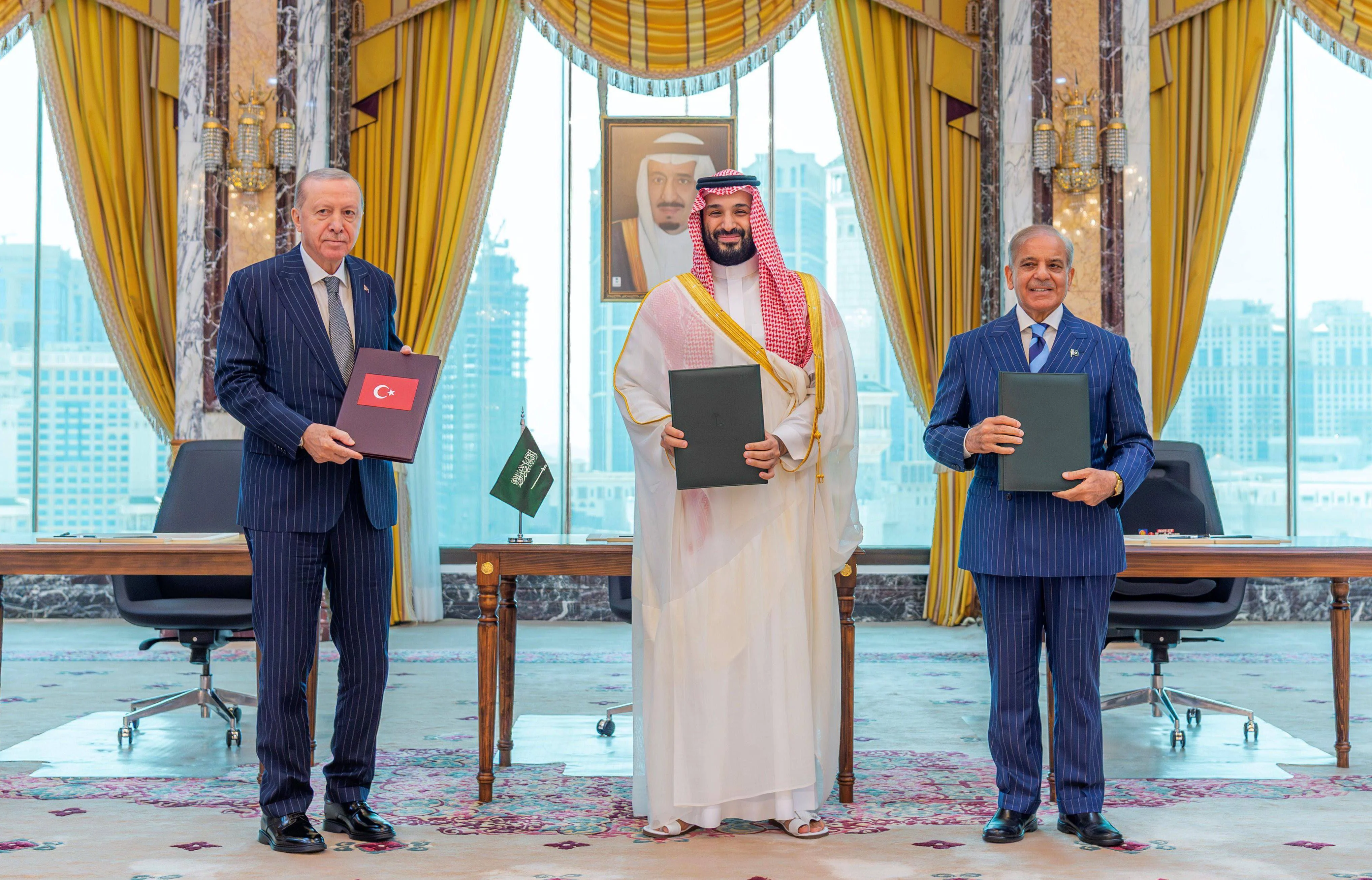

Houthi Attacks on Saudi Arabia Challenge Mecca Joint Defence Pact, Putting Pakistan to a Tough Test
Islamabad, Pakistan | October 4, 2026 | The Global Journal
Recent attacks on Saudi Arabia have raised fresh questions about the effectiveness of the Mecca Joint Defence Pact signed by Pakistan, Saudi Arabia and Türkiye. At the same time, the developments are highlighting the strategic and security challenges Pakistan could face as it seeks a greater role in West Asia.
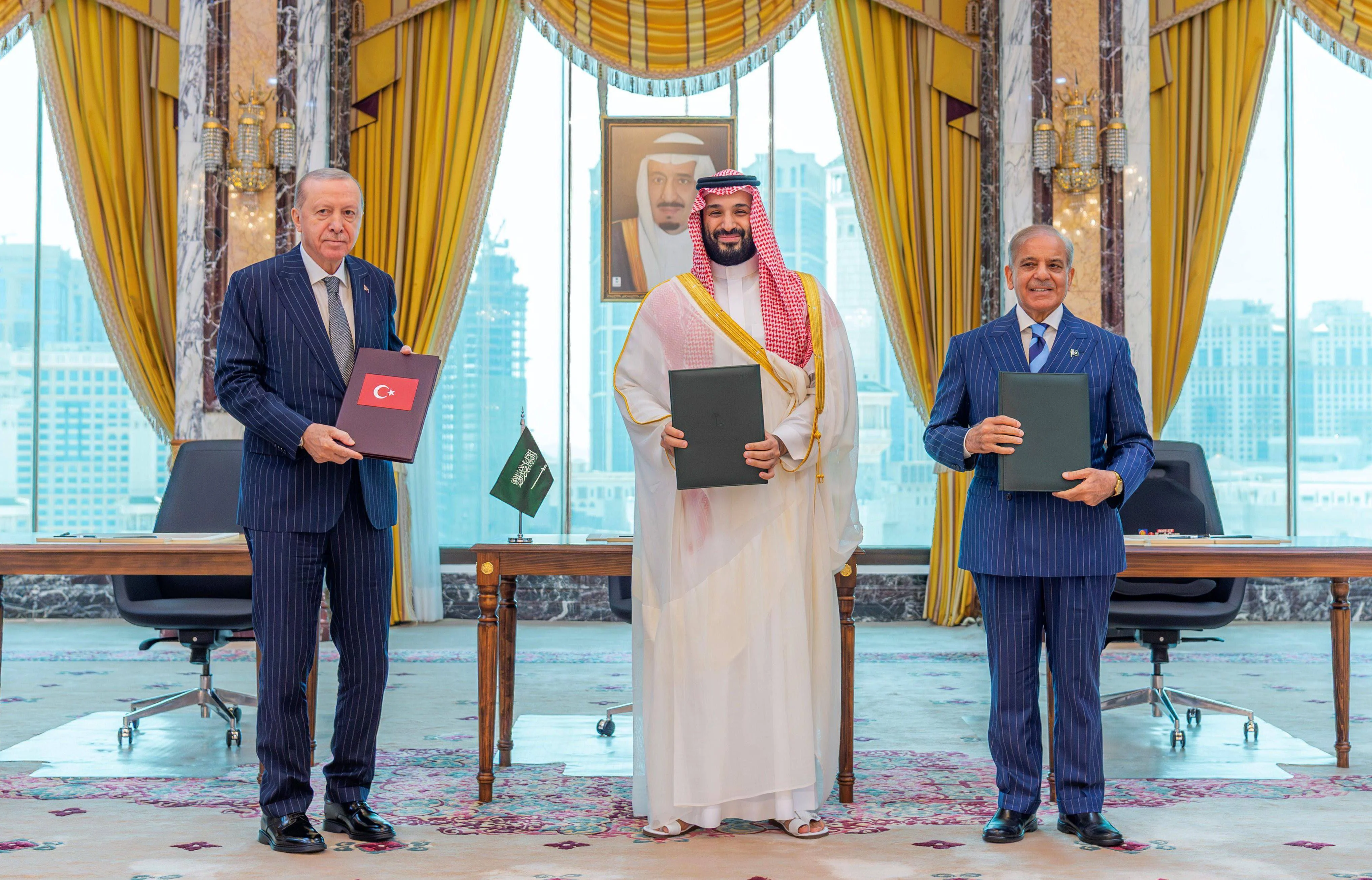
On August 7, Pakistan, Saudi Arabia and Türkiye signed the Mecca Joint Defence Pact in Makkah. Under the agreement, an armed attack against any one of the three countries is to be treated as an attack against all three. The pact was aimed at strengthening mutual deterrence and expanding defence cooperation.
With missile and drone attacks targeting Saudi territory, questions have emerged over how the defence commitments would work in practice. On October 1, the Saudi-led coalition for Yemen claimed that a September 29 drone attack on the Taibah Electricity Distribution Center, which supplies power in the area near the Prophet’s Mosque in Madinah, was planned and carried out by the Houthis. Saudi authorities said a transformer was damaged but the electricity network remained operational. The Houthis, however, denied the allegation.
Earlier attacks targeting various sites in Saudi Arabia have also been reported. With the regional conflict expanding and attacks on Saudi territory continuing, the pact’s central principle of collective deterrence is now facing a major real-world test.
Pakistan’s Commitment, but Questions Over Direct Military Involvement
Pakistan’s Defence Minister Khawaja Asif has recently said that, under the pact, Pakistan will support the defence of Saudi Arabia by “whatever means available.” However, he did not confirm whether Pakistani forces had already participated in any air strikes in Yemen. He also did not say whether Saudi Arabia had formally requested military assistance from Pakistan.
Pakistan’s senior military officials have also reiterated the country’s commitment to Saudi security. However, the practical military framework of the Mecca pact has yet to be fully developed. Pakistan’s Foreign Ministry has previously said that operational details—including how, when, where and what type of forces could be deployed under the agreement—are still being worked out and institutionalised.
Meanwhile, Pakistan’s Deputy Prime Minister and Foreign Minister Ishaq Dar has said that an emergency meeting of the Mecca Pact’s Strategic Political-Defence Committee will be held in Riyadh next week. The Houthi attacks on Saudi Arabia are expected to be among the key issues discussed.
Major Strategic Constraints Facing Pakistan
Despite its commitment to defend Saudi Arabia, direct Pakistani involvement in the Yemen war would not be an easy decision for Islamabad. Pakistan also wants to maintain diplomatic relations with Iran and has emphasised dialogue as a means of reducing regional tensions. Pakistan’s Foreign Ministry has said the country will continue supporting Saudi Arabia’s security while also pursuing dialogue and diplomacy to promote peace and stability across the wider region.
This position puts Pakistan in a delicate strategic balancing act. Saudi Arabia is a long-standing strategic partner, while the Houthis are widely viewed as close allies of Iran. Direct military action against the Houthis could therefore risk pulling Pakistan deeper into a conflict involving Iran.
Pakistan’s domestic security situation is another factor. The country is already dealing with several security challenges, including terrorism, armed activity in Balochistan and tensions along the Afghanistan border. Entering a new regional military front could therefore carry significant political and military costs for Islamabad.
Türkiye Also Signals Readiness
Türkiye, the third member of the Mecca pact, has also expressed readiness to cooperate on Saudi Arabia’s security. Turkish Foreign Minister Hakan Fidan has said Ankara is prepared to meet Saudi Arabia’s defence needs. However, the practical military implementation of the agreement remains complicated.
Analysts have pointed to the lack of fully developed military coordination, established operational procedures and activation mechanisms among the three countries.
As a result, despite continuing attacks against Saudi Arabia, questions remain over whether the Mecca pact can yet be considered a fully integrated military alliance comparable to NATO. Al Jazeera has also noted that while the agreement establishes a principle of mutual defence, its practical activation remains politically and institutionally complex.
Credibility of the Pact Faces a Major Question
The core strength of the Mecca pact is its promise that the other members will stand by any member that comes under attack. But with attacks on Saudi Arabia continuing, a fundamental question is emerging: how effective will that commitment prove in practice?
If Pakistan and Türkiye take direct military action, they could become deeply involved in the Yemen conflict. On the other hand, if they refrain from a direct military response, questions could arise over the pact’s deterrent power and its credibility as a future security arrangement.
Pakistan, meanwhile, appears to be seeking a balance between standing by Saudi Arabia and avoiding direct involvement in a wider regional conflict. With the framework of the Mecca pact still evolving, the upcoming meeting in Riyadh could prove important in determining the alliance’s future role.
The Saudi-Houthi conflict is therefore no longer simply a matter of security for Yemen or Saudi Arabia. It has emerged as the first major real-world test of the new Pakistan-Saudi-Türkiye defence framework. The actions taken by the three countries in the coming days could provide an important indication of whether the Mecca pact will develop into an effective defence alliance or remain primarily a political and strategic commitment.