
Balochistan’s Independence Movement, Calls for Imran Khan’s Release and Tensions Over the Indus Waters Treaty — How Deep Is Pakistan’s Crisis?
— Global Journal | Islamabad | September 6, 2026
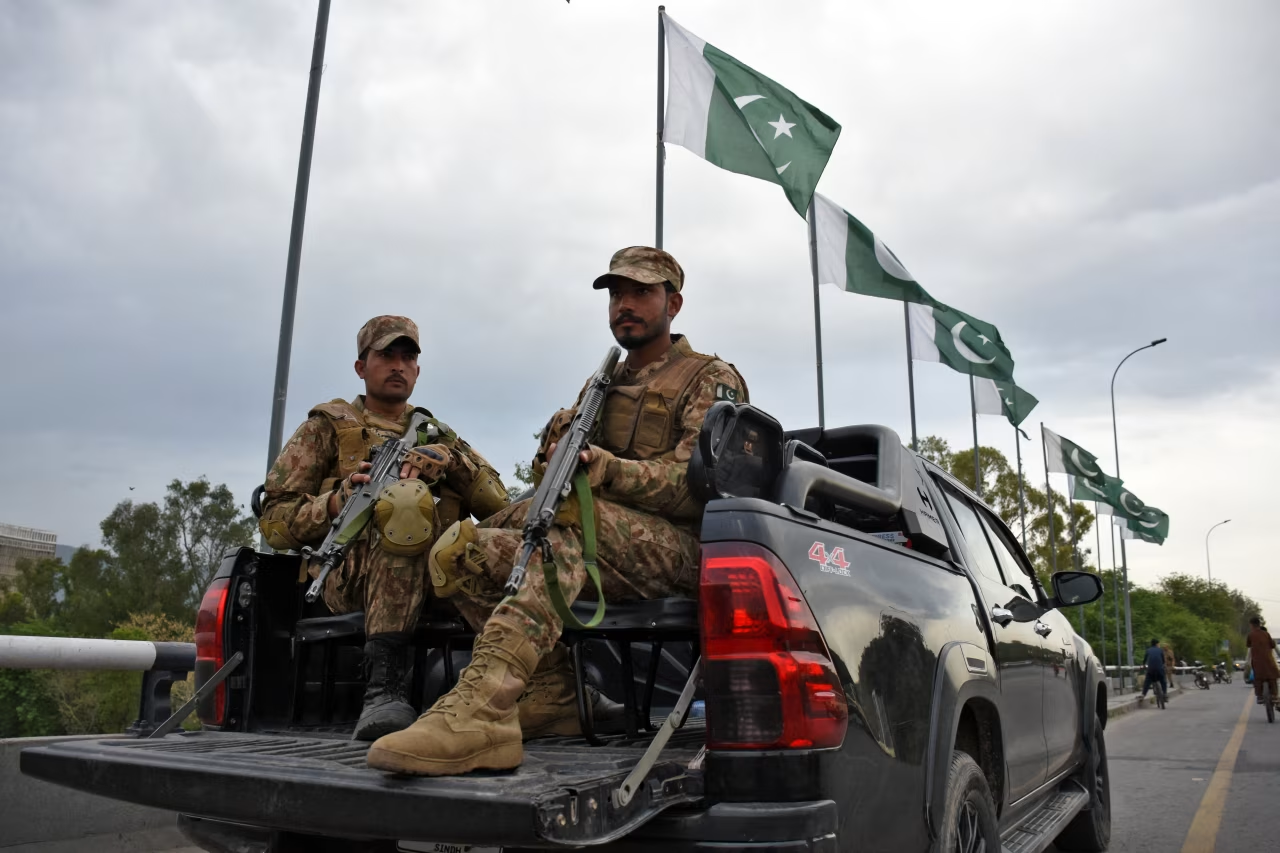
Political instability, an armed insurgency in Balochistan, the possibility of nationwide protests demanding the release of Imran Khan, and tensions with India over the Indus Waters Treaty have left Pakistan facing multiple complex challenges both domestically and internationally. At the same time, the growing role of the country’s military leadership in regional diplomacy surrounding Iran has added another layer of complexity to the situation.
Against this backdrop, former Pakistani diplomat Rajiv Dogra has described the country’s political and security situation as deeply troubled. In an interview with Firstpost, he discussed Balochistan, Imran Khan, the Indus Waters Treaty, Pakistan-US relations and the portrayal of Pakistani society in the film Dhurandhar, among other issues.
Political Uncertainty Surrounding Imran Khan
Former Prime Minister Imran Khan has been in prison for nearly three years, yet his influence on Pakistani politics remains significant. His supporters allege that multiple legal cases have been used to keep him politically sidelined. Pakistani authorities, however, maintain that Khan is a convicted prisoner serving his sentence under the law.
In the 2024 general election, independents backed by Khan’s Pakistan Tehreek-e-Insaf (PTI) performed strongly in terms of directly elected National Assembly seats, although the party itself was unable to contest under its electoral symbol. A coalition government subsequently came to power.
Khan’s close aide Zulfikar Bukhari recently told Reuters that if Khan were released, he would not seek direct confrontation with army chief Field Marshal Asim Munir. He also suggested that Khan could be willing to set aside personal differences and consider reconciliation. However, this was Bukhari’s assessment of what Khan might do, rather than a public commitment made by Khan himself.
Meanwhile, PTI is preparing for a nationwide mobilisation on September 27 demanding Khan’s release. Khyber Pakhtunkhwa Chief Minister Sohail Afridi has said he will lead a march towards Adiala Jail.
Pakistan therefore appears to be facing two contrasting political possibilities at the same time—potential confrontation in the streets and the prospect of political reconciliation behind the scenes.
Army Chief Asim Munir’s Growing Role in Iran Diplomacy
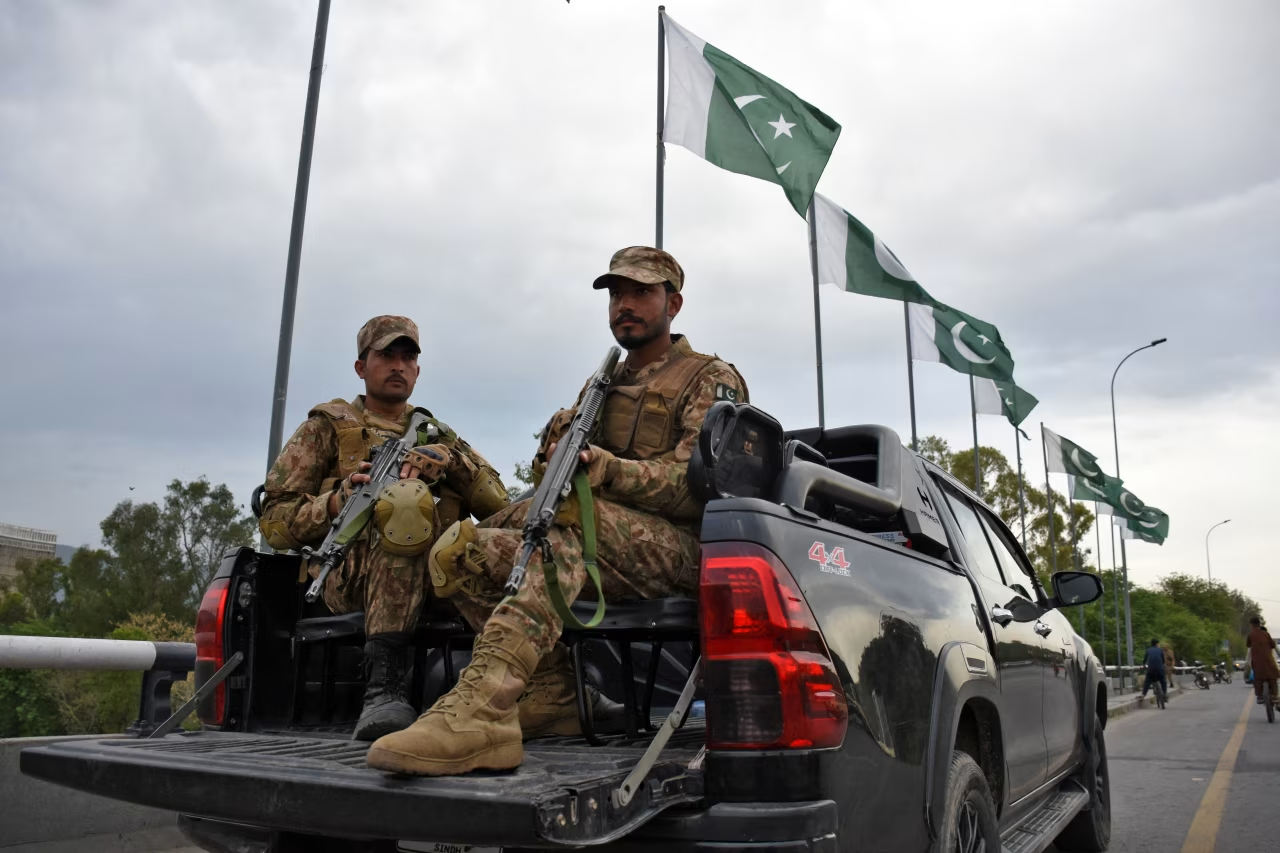
The international role of Pakistan’s military leadership has also expanded in recent months, particularly in diplomatic efforts concerning Iran.
According to Reuters, before travelling to Tehran, army chief Asim Munir spoke directly with US President Donald Trump, who asked him to use Pakistan’s influence to encourage Iran to return to negotiations.
Munir later travelled to Tehran with Pakistan’s Interior Minister Mohsin Naqvi. Pakistan subsequently said that the talks had made “significant progress.”
This diplomatic role presents a delicate balancing act for Islamabad. Pakistan has strong reasons to maintain close relations with the United States, while also sharing a long border and important commercial and security interests with Iran. At the same time, Pakistan has a deep strategic relationship with China and significant religious and economic ties with Gulf countries.
Munir’s involvement in Iran diplomacy therefore highlights both Pakistan’s growing international relevance and the extensive influence of the military leadership over the country’s foreign policy.
Is Balochistan Slipping Beyond Islamabad’s Control?
The situation in Balochistan remains one of Pakistan’s most serious security challenges. According to former diplomat Rajiv Dogra, the situation has spiralled beyond the control of Pakistani authorities, with effective government control increasingly limited outside urban areas.
Various armed groups, including the Balochistan Liberation Army (BLA), have been active in the province for years. Dogra believes the sustainability of their insurgency will depend largely on recruitment and local support.
He also warned that if the Tehreek-e-Taliban Pakistan (TTP) and the BLA become active against Pakistani security forces at the same time, pressure on the Pakistan Army could increase significantly.
India’s Indus Waters Policy
The 1960 Indus Waters Treaty remains one of the most important issues in India-Pakistan relations. Rajiv Dogra argues that the treaty has been unfair to India and that New Delhi should present its case more forcefully internationally.
In his view, India cannot simply suspend the treaty and stop there. As Pakistan raises the issue of water distribution internationally, India should also explain the historical context of the agreement and its own water-security requirements.
Dogra claims that long-standing restrictions on water management have negatively affected several water resources in Jammu and Kashmir. He supports a stronger Indian position on its rights to use its water resources.
However, his comments on water distribution and river management represent his personal analysis, and not all of his claims have been independently verified.
Memories of Violence in Karachi and the Dhurandhar Debate
Former diplomat Rajiv Dogra served in Karachi from 1992 to 1994. He recalls frequent armed clashes involving Muhajirs, Baloch and Pashtun groups, with conflicts over resources, drugs and criminal networks.
He also claimed that three days after the 1993 Bombay bombings, he attended a dinner in Karachi where he saw explosives and other equipment. He said a man present there was later identified to him as Tiger Memon. This is based on his personal recollection, and all details of the account have not been independently verified.
Discussing the film Dhurandhar, Dogra supported its depiction of a dark and violent side of Pakistani society. However, such a portrayal reflects a particular perspective and should not be treated as a comprehensive or universal representation of Pakistani society.
Closer US Ties — Relief or New Dependence?
Dogra also viewed the recent improvement in Pakistan-US relations through the lens of history. He argued that Pakistan has repeatedly used its strategic importance to secure economic and security benefits from Washington.
He referred to US analyst Bruce Riedel and his longstanding warnings about Pakistan, arguing that Washington has often understood the complexities surrounding Pakistan but has repeatedly adjusted its policies in response to changing geopolitical circumstances.
On the growing relationship between President Trump and Pakistan’s military leadership, Dogra suggested that economic prospects and business interests could also be influencing the relationship.
Pakistan Faces Multiple Crises at Once
The most significant feature of Pakistan’s current situation is that these crises are interconnected rather than isolated.
Imran Khan’s political influence, a potential PTI mobilisation, the insurgency in Balochistan, the security threat posed by the TTP, tensions with India over water and the expanding role of the military leadership in international diplomacy are all putting pressure on Islamabad simultaneously.
Should the September mobilisation become a major movement, it could create new pressure on Pakistan’s domestic political balance. Conversely, if signals of reconciliation from Khan’s camp develop into meaningful political dialogue, there may be an opportunity to reduce tensions.
The larger question is whether Pakistan can resolve its internal political challenges while maintaining its growing diplomatic role in the region—or whether efforts to manage one crisis will simply deepen another.
— Global Journal | Islamabad | September 6, 2026
Sources: Firstpost, Reuters and international news reports