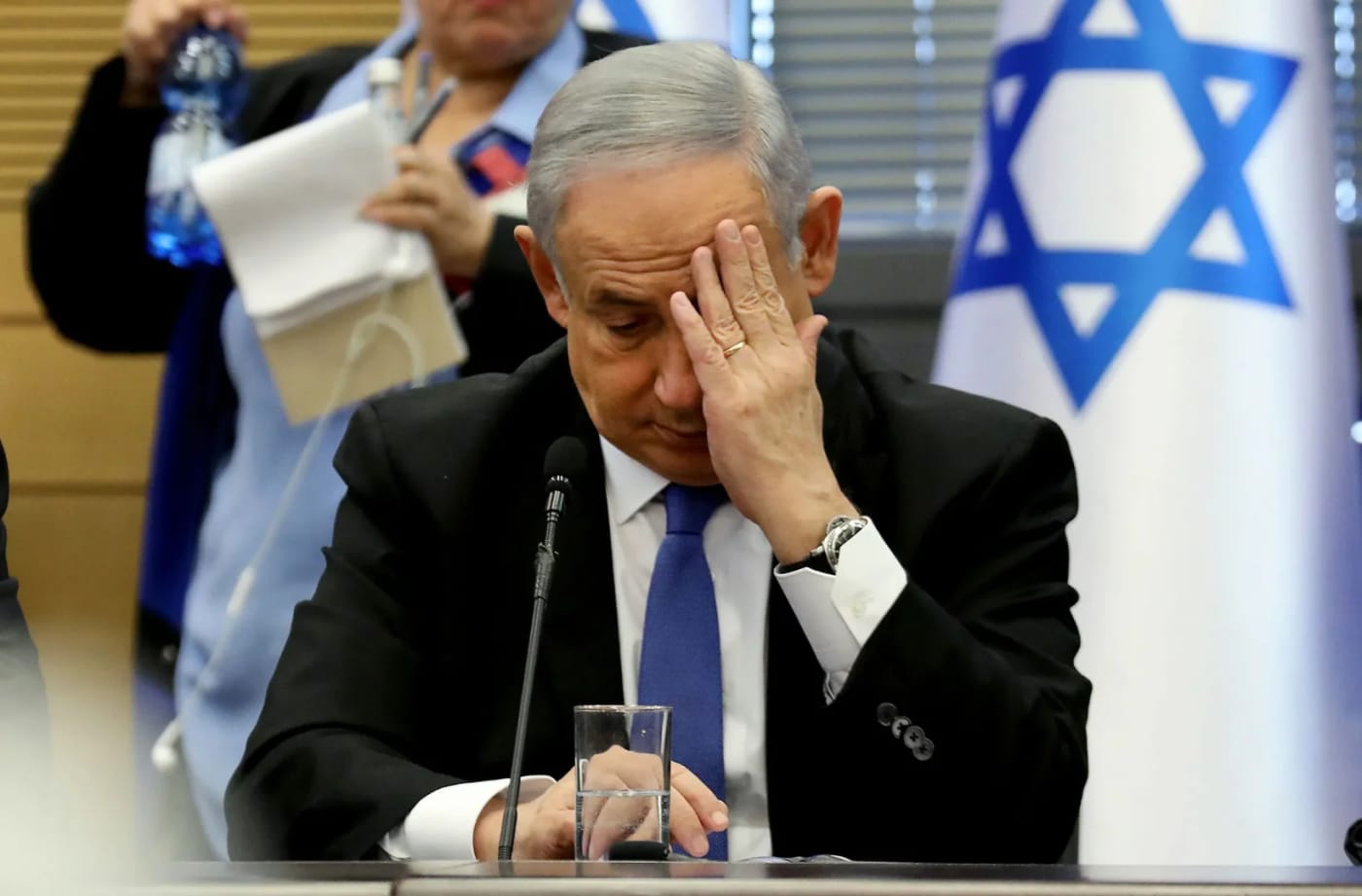

Netanyahu Faces Possible Loss of Premiership as Opposition Leaders Unite to Form Coalition Against His Government
Herzliya, Israel | November 3, 2026 | The Global Journal
Leaders of four Jewish-led opposition parties in Israel have agreed to begin coalition talks aimed at removing Prime Minister Benjamin Netanyahu's government from power. At a meeting held in Herzliya on Tuesday (November 3), they decided to launch negotiations swiftly and coordinate parliamentary strategies ahead of the opening of the newly elected Knesset (Israel's parliament) next week. However, they have yet to identify a clear path to forming a government without the support of Arab parties.
In the October 27 election, Netanyahu's coalition secured 53 seats. Meanwhile, four Jewish opposition parties opposed to Netanyahu won a combined 48 seats. A majority of 61 seats is required to form a government in Israel's 120-member Knesset. Consequently, the opposition needs the support of two Arab-led parties, which collectively secured 19 seats, to achieve a parliamentary majority. This political arithmetic has made the formation of a new government a complicated challenge.
Effort to Form a Government Under Eisenkot's Leadership
Tuesday's meeting was attended by Gadi Eisenkot, leader of the Yashar Party; Naftali Bennett, chairman of the B'Yachad Party and former prime minister; Yair Golan, head of the Democrats Party; and Avigdor Lieberman, leader of Yisrael Beiteinu. Yair Lapid, a senior B'Yachad leader and outgoing opposition leader in the Knesset, was also present.
In a joint statement issued after the meeting, the leaders pledged to replace Netanyahu's government and establish a national emergency government. They also announced plans to pursue the formation of a new government based on four principles proposed by Yashar leader Gadi Eisenkot.
The principles include recognising Israel as a Jewish and democratic state, committing to the values of the Declaration of Independence, ensuring mandatory military service for everyone, and recognising Hamas as a terrorist organisation while dismantling its military capabilities in Gaza and ending its rule there.
The opposition leaders also agreed to recommend to President Isaac Herzog that Gadi Eisenkot be given the first opportunity to form a government. They further decided to instruct their negotiating teams to immediately begin preparing a coalition agreement and policy guidelines.
Plan to Replace the Knesset Speaker
One of the opposition's first moves when the new Knesset convenes could be an attempt to remove Likud lawmaker Amir Ohana from the position of Knesset speaker. Such a move could create an opportunity to advance several legislative proposals that have faced resistance from Netanyahu. Among them is the establishment of a state commission of inquiry into the Hamas-led attack in southern Israel on October 7, 2023.
According to a report by The Times of Israel, the opposition leaders also discussed replacing Ohana with Yair Lapid as Knesset speaker. However, they said a final decision on the matter would be made next Monday.
Disagreements Among Opposition Leaders Over Support from Arab Parties
The question of cooperation with Arab parties has emerged as the biggest obstacle to the opposition's efforts to form a government.
Democrats Party leader Yair Golan has publicly supported cooperation with Arab-led parties. Before Tuesday's main meeting, he held talks with Joint List leaders Yousef Jabareen and Ahmad Tibi. It was their first meeting since the election.
According to a statement from Golan's party, the discussions focused on coordinating efforts to remove Netanyahu's government by using the parliamentary majority, as well as addressing key issues affecting Arab communities and finding practical solutions.
Both sides agreed to maintain coordination ahead of the next political steps aimed at forming a government of change.
However, the other opposition leaders have expressed reservations about including Arab parties in a governing coalition. Lieberman has also opposed the formation of a minority government dependent on Arab parties' support. On Tuesday, he argued that a stable government could be formed without their backing. However, he did not provide a detailed explanation of how such an arrangement would work.
Bennett and Lapid Call for Swift Government Formation
Following the meeting, Naftali Bennett reaffirmed his party's full support for Gadi Eisenkot's efforts to form a government. He said all members of his party would make every possible effort to help Eisenkot establish a government quickly. There was no time to waste, he stressed, calling for immediate action.
Before attending the meeting, Yair Lapid said serious and dangerous attempts were underway to undermine the election results. He said forming a government was essential and that recent developments had once again demonstrated the need to remove Netanyahu from the prime minister's office.
Netanyahu Criticises the Opposition's Initiative
As opposition parties work on their coalition plans, Netanyahu and his Likud Party criticised their efforts on Tuesday.
In a statement, Likud said that while Netanyahu had extended an offer of cooperation to form a broad national unity government, the opposition was seeking to establish a dangerous government dependent on the support of Arab parties.
Likud further alleged that several potential members of the opposition coalition were reluctant to recognise Hamas and Hezbollah as terrorist organisations.
However, opposition parties have rejected Netanyahu's proposal for a national unity government. They have held him responsible for the government's failures before and after the October 7, 2023, Hamas attack.
Meanwhile, Likud has accused Qatar or other foreign powers of secretly financing efforts to influence Arab voters and affect the election results. However, no evidence has been made public to substantiate these allegations. A request to delay the formal approval of the election results was also rejected by Supreme Court Justice Noam Sohlberg, who is overseeing the electoral process.
Government Formation Remains Uncertain, Another Election Possible
Although Netanyahu's coalition secured 53 seats, it falls short of the 61-seat majority required to form a government. Similarly, the 48 seats held by the Jewish opposition parties are insufficient to establish a government on their own. The opposition must therefore seek support from Arab parties, reach other political agreements or explore alternative coalition arrangements.
Israeli President Isaac Herzog is expected to begin consultations with representatives of the newly elected parties on Wednesday. Following these consultations, he will decide whom to task with forming the next government. If no party or coalition succeeds in forming a government within the stipulated period, Israel could face another election.
Overall, although opposition parties have begun discussions aimed at removing Netanyahu from power, the formation of a new government remains uncertain. Differences among opposition leaders over cooperation with Arab parties, combined with the challenge of securing a 61-seat majority, have created fresh uncertainty in Israeli politics.
Sources: The Times of Israel, Associated Press (AP), The Jerusalem Post.